
New submission: The risks of SIL commissioning | Supports | Choice and control | NDIS
| Policy and Advocacy | News
| Text only
| Supports | Choice and control | NDIS
| Policy and Advocacy | News
| Text only

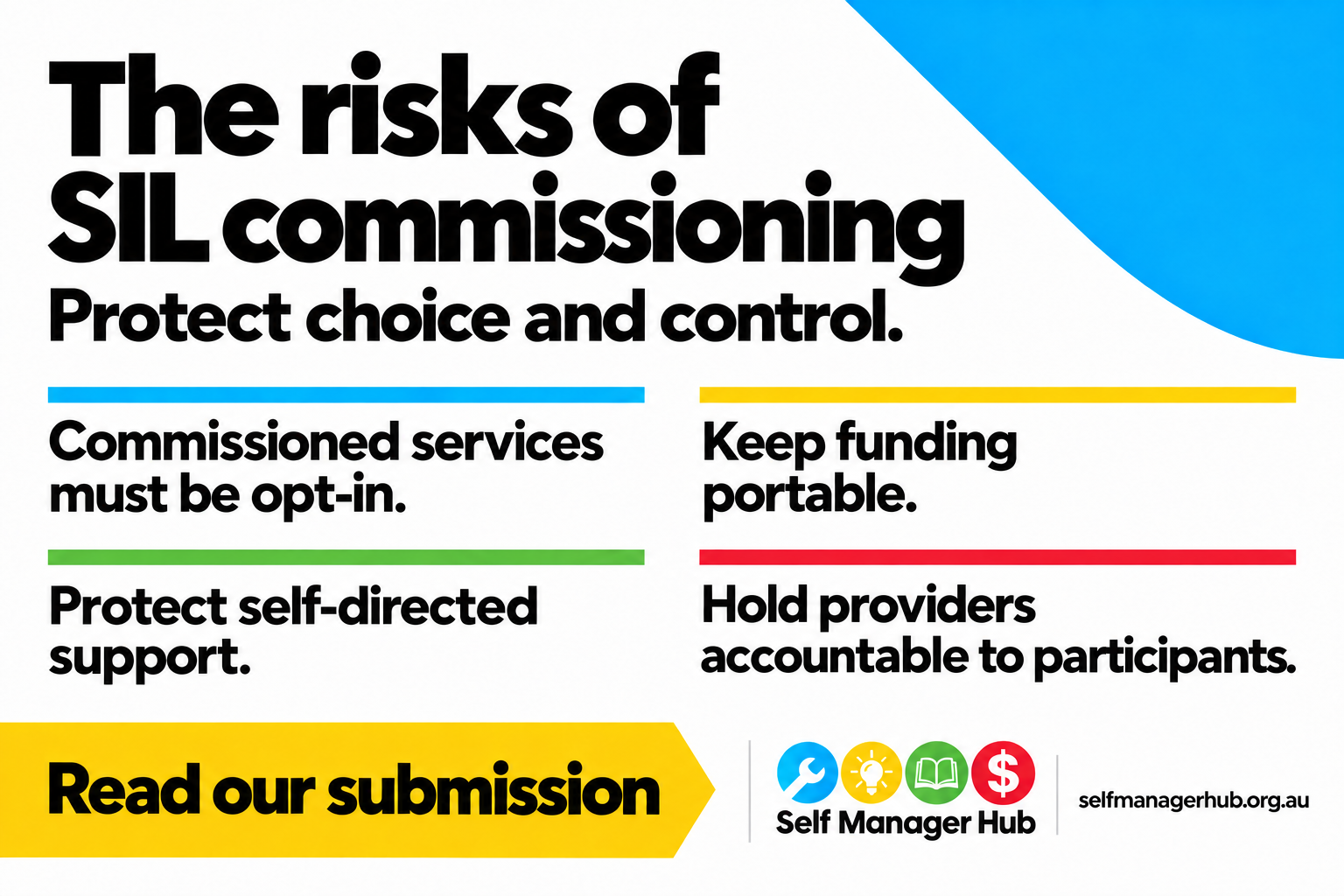
People with disability must remain in control of who provides our support. That is the central message of Self Manager Hub’s new submission to the Department of Health, Disability and Ageing.
Our submission responds to the consultation Supported Independent Living (SIL): What does good look like? Self Manager Hub is calling for clear protections for individualised and portable funding, safeguarding of participant choice and control, and greater provider accountability.
Why we are concerned about commissioning
The consultation considers “commissioning”, where government takes a more active role in planning, funding, and overseeing services.
Our concern is that this could lead to people being required to use a small number of government-selected providers. This would limit who can support us in our own homes.
When people cannot easily leave a provider, providers have less reason to listen and respond. Restricting choice can also shut out small, innovative, and participant-led services.
Choice and control are safeguards. Being able to leave an unsafe provider and take your funding elsewhere is a vital protection.
What we are calling for
Our submission sets out practical recommendations to protect people’s rights and improve support.
- Make commissioned services strictly opt-in. People must actively choose to join and be free to decline or leave without losing funding, housing, or essential support.
- Keep funding with the person. Funding must follow participants when they change providers or choose a different living arrangement.
- Protect existing arrangements. Commissioning must not disrupt chosen workers, direct employment, self-management, or self-directed and individualised supports. These options must remain available to new participants too.
- Keep provider choice open. Participants must be able to choose outside government panels. Where panels exist, we call for at least three provider options, including in regional and remote communities.
- Protect control over home life. People must not be forced to share support, accept particular housemates, or follow group routines. Changing support providers should not put someone’s home at risk.
- Strengthen independent safeguards. Fund advocacy, supported decision-making, and accessible information. Require rapid action on complaints and protect people who speak up.
- Build more options where services are limited. Commissioning should add services or provide a service of last resort, with participation remaining voluntary. Local people with disability must help make these decisions.
- Support quality and innovation. Invest in fair pricing, workforce development, and pathways for small, specialist, and participant-led providers.
- Share decision-making and publish the evidence. People who use SIL must help design any changes. Government must publish its proposals and protections, with independent evaluation of any voluntary pilot.
What good support looks like
Good support respects our decisions about who enters our home, how we spend our time, and how we participate in our community. It provides reliable workers who understand our needs, have the right skills, attitudes, and act according to our individual preferences.
Needing support around the clock must never become a reason to take these decisions away from us.
Our submission is grounded in the lived experience of people who self-manage or self-direct their supports, including people with high and complex support needs.
Read and share our submission to help us make the case for safer, more individualised support that keeps people with disability in control.