
Workshop: SCHADS Award changes for people who directly employ support workers | NDIS | News | SCHADS
| Build your team | Rules for hiring | Events | News
| Event
| NDIS | News | SCHADS
| Build your team | Rules for hiring | Events | News
| Event

If you directly employ your disability support workers, changes to the SCHADS Award may affect what you pay and how your workers are classified. A pay change for certain workers starts in December 2026. A broader classification change is scheduled for October 2027. The first step is to check which part of the Award applies to each worker now.
What changes in December 2026
From the first full pay period on or after 1 December 2026, minimum rates for employees currently classified under Schedule E as Home care employees in disability care will rise. For most affected classifications, the increase is 15 per cent. Two classifications have slightly smaller increases: 14.96 per cent for Level E.4.2 and 13.31 per cent for Level E.5.2.
The Fair Work Commission moved this change from October to December to give more time to prepare. The increase applies to the Award minimum rates for the affected classifications. It does not automatically mean every worker’s actual pay rises by 15 per cent, particularly if they are already paid above the new minimum.
Does the December increase apply to every support worker
No. The December change is for workers currently covered by the relevant Schedule E disability care classifications. Disability support workers have historically been employed under both Schedule B and Schedule E. The Fair Work Commission has recognised that this has caused confusion, especially where support is provided in a person’s home.
If you directly employ workers, check their current Award classification and pay rate. Your employment agreement, payslips and payroll records may help. If you are uncertain whether the classification is correct, seek qualified workplace or payroll advice before changing pay arrangements.
What changes in October 2027
From 1 October 2027, a new classification structure is scheduled to replace the current Schedules B, C, E and F. Existing workers will need to be classified under the new structure. The Fair Work Commission has said disability support work will sit in the social and community services stream, wherever the work takes place, including in a private home.
The new classification depends on the work a person actually does, together with relevant skills, qualifications, experience and responsibility. A job title alone may not tell you the correct level. The Commission has published translation arrangements to help move existing workers across, and the final determination for the 2027 changes will be published closer to commencement.
What if the new minimum rate is lower
The planned translation rules retain a minimum rate for an existing worker that is the higher of the new classification rate and the Award minimum rate they were entitled to immediately before the change, including the Equal Remuneration Order where it applied. This protects the worker’s existing Award minimum rate at the point of transition. It is still important to check the correct classification and actual pay for each worker.
Personal support and domestic work
The new structure distinguishes disability support work from home care disability work. Work that involves directly supporting a person with disability, including personal care, falls within disability support work. Work consisting only of domestic assistance or home maintenance may fall within home care disability work. If a worker performs a mix of tasks, look at their actual duties and get advice if the classification is unclear.
What happened to 24 hour care
The 24-hour care clause allows an agreed arrangement in which a worker is available in a person’s home for 24 hours, provides up to eight hours of care, and is paid for eight hours at 155 per cent of the appropriate rate. Extra hours worked are paid as overtime.
There was concern that the new classifications would unintentionally remove access to this arrangement for people receiving personal care at home. The Fair Work Commission amended the wording so it can continue to apply to workers providing personal care to a person with disability in a private residence. The Commission has also said it may consider how 24-hour care interacts with sleepovers and broken shifts in future.
What should direct employers do now
- Check each worker’s current Award schedule, classification and rate of pay.
- Work out whether the December Schedule E increase applies and when your next full pay period begins.
- Review your payroll costs and NDIS budget, including the effect on penalties, leave and on-costs where relevant.
- Keep a record of each worker’s duties so you can prepare for the 2027 classification change.
- Ask for qualified advice if you are unsure about classifications, the 24-hour care clause or how to implement a new rate.
The Fair Work Commission decision sets the Award changes. How they affect your workers will depend on their actual classification and pay arrangements.
Join our free workshop
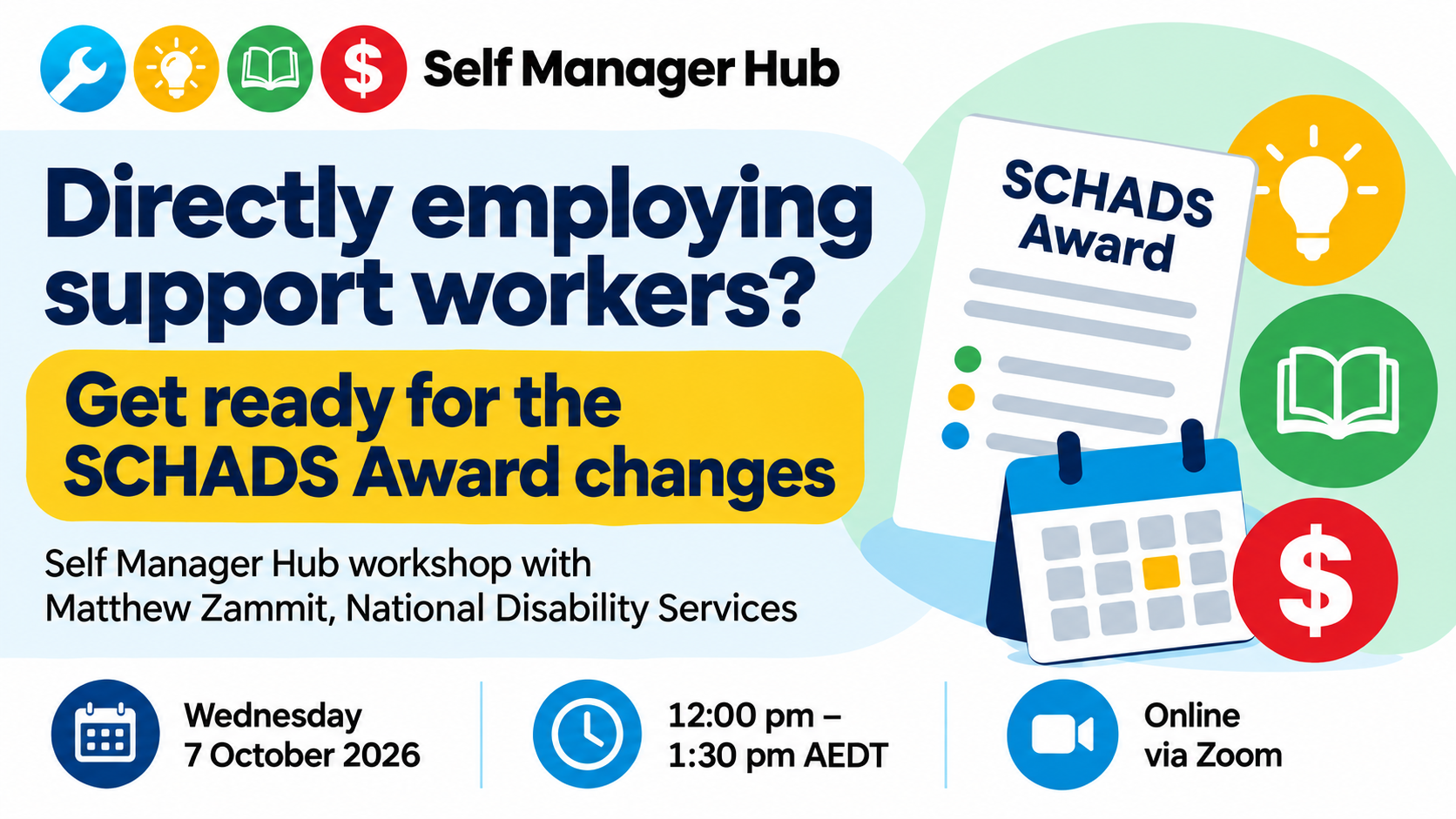
Self Manager Hub is hosting an online workshop with Matthew Zammit, Industrial Relations Lead at National Disability Services. He will explain the changes in plain English and answer questions from people who directly employ support workers.
🗓️ When: Wednesday 7 October 2026; 12pm – 1.30pm (AEDT)
📍 Where: Online via Zoom
FREE but you must register via Humanitix:
Source: Fair Work Commission, [2026] FWCFB 232 (11 September 2026), especially paragraphs [1], [3], [9], [17] and [24]–[27], and the attached classification translation arrangements. https://www.fwc.gov.au/hearings-decisions/major-cases/gender-based-undervaluation-priority-awards-review