
NDIS support lists are changing: have your say | Supports | Choice and control | NDIS
| NDIS Fund Management | Policy and Advocacy | What can I buy? | News
| Text only
| Supports | Choice and control | NDIS
| NDIS Fund Management | Policy and Advocacy | What can I buy? | News
| Text only
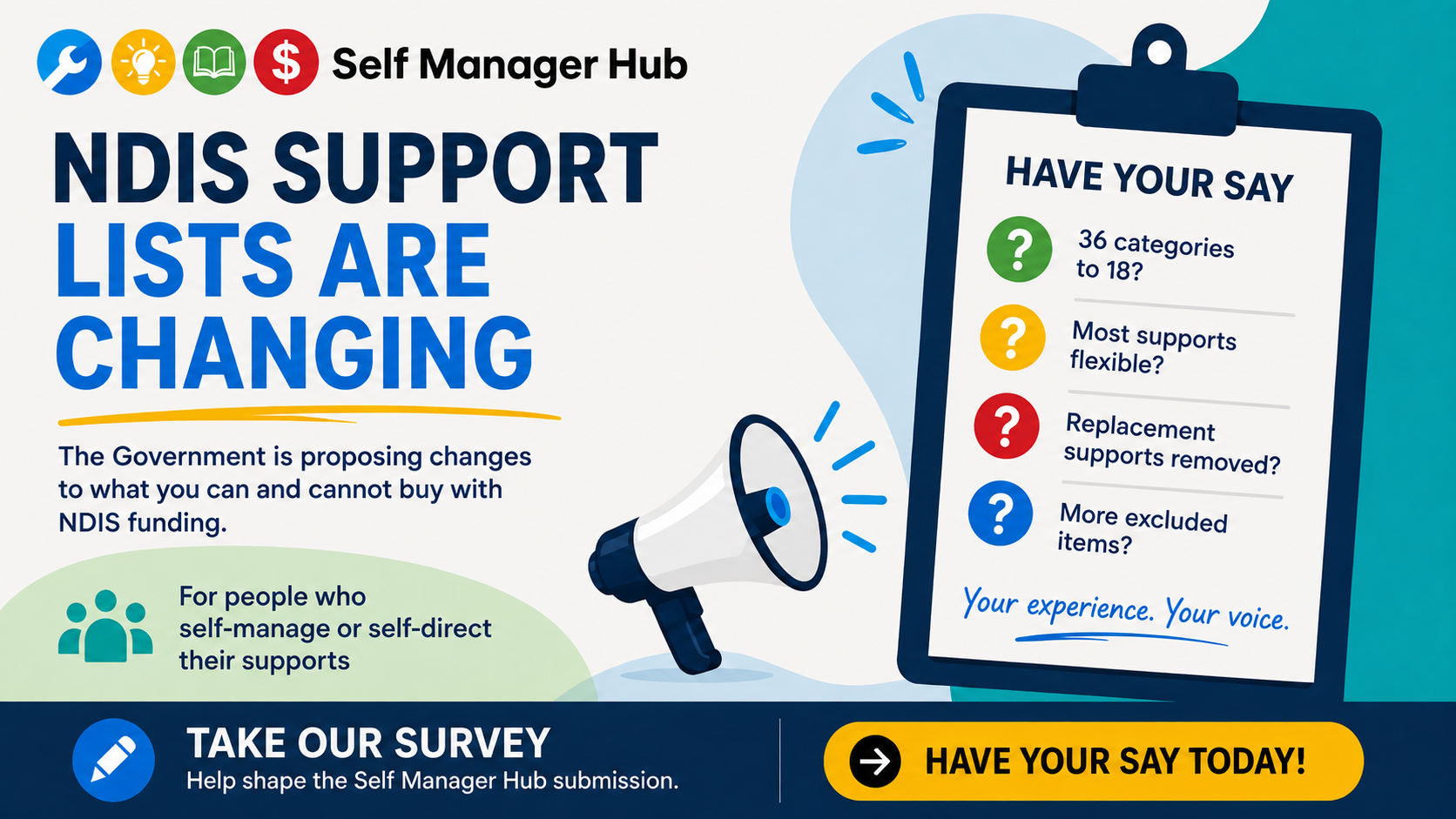
August 2026 – The Government is asking for feedback on some major changes to the NDIS support lists. Yes, those lists that many of us find confusing and hard to understand.
While they can be frustrating, they are also very important. They set out what you can and cannot use your NDIS funding to buy.
For people who self-manage or self-direct their supports, the changes could increase flexibility in some areas but reduce it in others. So, it is important that we have a say about the changes the Government is planning to make.
The Government consultation is open now and closes on 14 October 2026.
Help shape the Self Manager Hub submission
Self Manager Hub will be making a submission to the Government, and we want your voice to be part of it.
We have created a short survey for people who self-manage or self-direct their supports, and our families.
We want to know what you think about the proposed changes, what worries you, what you support, and what the Government needs to get right.
Your responses will help us make sure our submission reflects the real experiences and concerns of our community.
Take the Self Manager Hub survey
The survey has 6 questions and should take about 15 minutes.
What is changing?
One of the biggest changes is a plan to simplify the NDIS support lists.
The Government proposes reducing 36 support categories to 18 and using broader descriptions based on the purpose of a support, rather than provider registration groups.
Some of the most important proposed changes are:
- A new, broad “In-home and community supports” category. This would bring together many supports that are currently separated, including personal care, household tasks, community participation, group activities, some life skills supports, and high-intensity daily personal activities.
- Most supports are proposed to be flexible. This could allow people to use funding across supports within a category, as long as the support meets the NDIS support rules and relates to their disability support needs. Some supports would still be “stated”, meaning funding must be used for a particular support or category.
- Assistive technology would be simplified into broader categories. Mobility equipment, communication equipment, hearing and vision equipment, and other assistive products would sit within broader assistive technology categories.
- You would be clearly allowed to buy suitable assistive technology and consumables from ordinary retailers, such as pharmacies, hardware stores, and other mainstream shops. You would not have to use a disability-specific supplier just because you are using NDIS funding. This is a welcome clarification for self-managers.
- The replacement supports process would be removed. Tablets, smartphones, smart watches, and accessibility or communication apps could instead become stated supports when approved as reasonable and necessary or linked to an assessed need. Other ordinary household items would no longer be available through the replacement supports process.
- More things would be added to the “not an NDIS support” list. The proposed additions include electronic noise-cancelling headphones, fencing and gates, hair styling tools, hydrogen fuel and electric vehicle charging costs, and scuba therapy.
Why could this be good for self-management?
There are some positive ideas here.
Moving away from categories based on provider registration groups could help make the NDIS more focused on what support a person needs rather than what type of provider delivers it.
The new “In-home and community supports” category could also give people more freedom to organise support around their own lives. The proposed wording says these supports can be delivered in an individual or shared setting, which is important for people with highly individualised support arrangements.
Making it clear that assistive technology and consumables can be bought from ordinary retailers is also sensible. Self-managers often find better, cheaper, or more suitable products outside the disability market.
What should we be concerned about?
Broader categories could create more flexibility, but only if the rules are applied that way.
We need to make sure the examples in the rules do not become an unofficial checklist that limits innovative or highly individualised supports.
We also need to watch how stated supports are used. If too many supports are stated, funding can become locked into particular purposes. That could reduce the flexibility that makes self-management work.
The removal of replacement supports is another major issue. The current system is difficult, but removing it altogether may take away an important pathway for people who find a cheaper or more practical mainstream solution.
The Government says tablets, smartphones, smart watches, and some apps could instead be put into plans as stated supports. But this may mean people need approval in their plan before they can use funding for them.
There is also still a lot we do not know. The consultation paper says some important parts of new framework planning, including detailed budget settings, are still being developed and tested.
Have your say
This is an important consultation for people who self-manage or self-direct their supports.
Think about the supports you use now.
- Would they clearly fit within the new categories?
- Would the new rules give you enough flexibility?
- Are there supports that could fall through the gaps?
- Could making more supports “stated” reduce your choice and control?
- Could removing replacement supports make it harder to find practical or cheaper ways of meeting your needs?
The Government is specifically asking about unintended impacts and practical problems. This is our opportunity to explain what these changes could mean in real life.
Tell Self Manager Hub what you think
Please take our survey and help shape the Self Manager Hub submission.
We will use the responses to identify the issues that matter most to people who self-manage or self-direct their supports and to bring the experiences of our community directly into our submission.
Take the Self Manager Hub survey
You can also make your own submission directly to the Government.
Government consultation closes 14 October 2026.